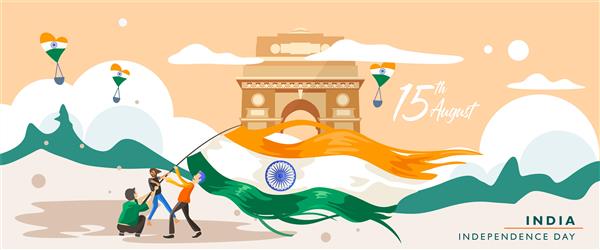
From Stripes to Stars: India’s 77th Independence Soars with Hope

As the tricolor flag unfurls once again against the azure skies, marking the 77th year of India’s hard-fought independence, a surge of pride and patriotism sweeps across the nation. Every corner of this diverse land reverberates with the echoes of sacrifice, courage, and the unyielding spirit of the countless heroes who envisioned a free India. This Independence Day, we not only celebrate our past but also embrace the boundless opportunities that lie ahead – in development, empowerment, technology, and space exploration.

Development: Paving the Path to Progress
From the struggles of post-independence years to the present, India has come a long way. The relentless efforts of its people and leaders have borne fruit in the form of unprecedented economic growth, technological advancements, and infrastructural marvels. As we celebrate 77 years of independence, let’s remember that true development lies not just in towering skyscrapers but in the upliftment of every citizen. Together, we’ve built a nation where digital literacy and access to education are shaping young minds, transforming them into the architects of tomorrow’s India.

Empowerment: Igniting Minds, Fostering Dreams
Our nation’s strength lies in its people. The youth, armed with passion and determination, are the torchbearers of our future. As we celebrate this Independence Day, let’s empower our young minds with knowledge, resources, and the unwavering belief that they can create positive change. From rural villages to urban centers, let’s provide equal opportunities for growth and innovation, ensuring that every dream finds wings to soar.

Technological Advancements: Scripting the Digital Saga
The 21st century has witnessed India’s meteoric rise in the realm of technology. From pioneering startups to groundbreaking innovations, the nation has embraced its digital destiny with open arms. As we hoist the flag on this special day, let’s celebrate the fact that India is not just adapting to technological advancements but actively shaping them. Our youth is writing codes that power global platforms, and our entrepreneurs are redefining industries. This Independence Day, let’s pledge to continue this journey of technological excellence, making India a digital powerhouse on the world stage.

Space Missions: Touching the Stars, Inspiring Generations
In the vast expanse of space, India has carved its name with pride. The achievements of the Indian Space Research Organisation (ISRO) have not only placed us among the world’s space-faring nations but have also ignited a passion for science and exploration among the youth. Chandrayaan 2’s journey to the moon and India’s successful Mars Orbiter Mission (Mangalyaan) reminds us that the sky is not the limit – it’s just the beginning. As we commemorate this Independence Day, let’s inspire the young minds of India to reach for the stars and contribute to the realm of space exploration.

Envisioning a Glorious Future Together
As the tricolor flutters in the wind, it reminds us that the soul of India is rooted in its diversity, resilience, and unbreakable unity. This Independence Day, let’s celebrate the journey of 77 years with a heart full of gratitude for our forebearers who fought for our freedom. Let’s also look forward with hope and determination, recognizing that our development, empowerment, technological prowess, and space explorations will define our nation’s destiny.

To the youth of India, remember that the future belongs to you. Let the stories of our past inspire you, the opportunities of the present propel you, and the dreams of a better India guide you. As the tricolor stands tall, it’s a reminder that the heartbeats of over a billion people throb in unison, shaping a nation that’s destined for greatness.

Let your dreams be the compass and your determination the fuel, as you navigate the path towards a resplendent India.

– Lalith Kumar Vemali

Happy 77th Independence Day, India!
Jai Hind!

Social Media Networking Apps: e-Learning Series

Education needs social media intervention in order to explore ways towards providing learning breaking barriers.

I have gone through very interesting site yesterday by name “Edmodo” which creates free online tools for the education community,  for Schools, Teachers, Students, and parents for use in classroom. It is a social learning network for teachers, students, schools and districts. Provides free classroom communication for teachers, students and administrators on a secure social network. It allows the education community to share classroom materials, links , grades, calendar and notices. It even shares all digital content, blogs, pictures, videos, presentations etc. The interesting aspect is that, it is accessible online or by using any mobile device, including Android and i Phones.


Edmodo webpage


I felt like, we have many resources which we can utilize at certain and required levels, but the education community is yet to open its wings in  order utilize this simple applications which really helps the teaching and student community providing way for shared knowledge, as many times i say, Knowledge when not shared, it is mere waste.

Knowledge Networking really gonna be the 21st century buzzword which is the next level of Social Media Networking, as far as i feel till date 🙂

Wait for the next Social Media App 🙂

ICT based Teacher Training

Change is to be accepted, As we are marching towards 21st century carrying Information, Communication, Technology as buzz words with us. One can see rapid transformation in the methodologies of teaching. Today children are getting lot of exposure towards learning new things and lots of questions from their little minds. A question to all of us – Are we ready to face those questions ?

The answer may be Yes or No !  But we should be able to answer atleast few questions, as we would guide them upto certain level. Hence it came in my mind, Teachers and parents need to have ICT based training.

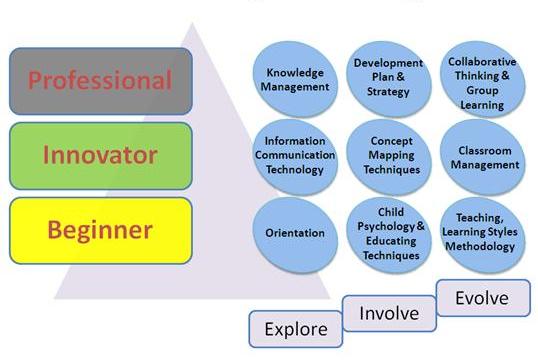
ICT based Training means, usage of Technology and its support to teachers. Along with the Teacher training curriculam one needs to under go training with regards to usage of PC, Digital boards, etc.  We can also add concept mapping based education in order to encourage the teacher to train the student in a problem solving orientation and inquiry based education, this would lead to creative and innovative thinking both from the teacher and student mindset.

Levels of Training
Teach the Teacher

Each level is categorized with different methods of learning and a collaborative approach would really hel teachers to sustain themselves in a Learn – Un Learn – Re Learn atmosphere.

Learning is part, but implementing effectively is a process where Un learning takes place and innovation arises, this is where every teacher need to concentrate and this would really be helpful for a better student upliftment.

Future – ICT in Education sector

Knowledge, Networking, ICT, Education, Socializing, Society

Use of ICT in the education sector, though recent, has picked up fast.

Computer has bought the revolution in the field of education exploring and expanding towards new extremes. Thanks to Social Networking which added pepper to give it a perfect blend. Previously cable television was the medium for expanding the education, coaching classes set up dedicated channels for distance learning. Then VSAT technology extended this to remote regions. Now it is digital television with service providers beaming educational programs for school children into homes and schools. That’s where ICT comes into picture.

We have been witnessing lots of radical changes and fast paced growth in education sector all over the world supported by factors like:

  • Digital / Technological Revolution
  • Social Networking
  • Telecom Coverage
  • Hardware Penetration (Laptops, PC etc)

So far we haven’t used much of these Upto satisfactory levels! Infact if we question ourselves, is education reaching all?

It had just begun; we started identifying Information Communication Technology as a medium. Using of technology for delivering has started in most of the developing countries, this would be a good sign, as in developed countries opportunities for education are little ahead.

Availability of prospective and transformative education system is considered to be a crucial factor for the development of human resources for any country, ensuring that fruits of economic growth reach the masses and the development is sustained. The thrust of global economies to emerge as the knowledge economy has also reinforced education as the key economic and business driver.

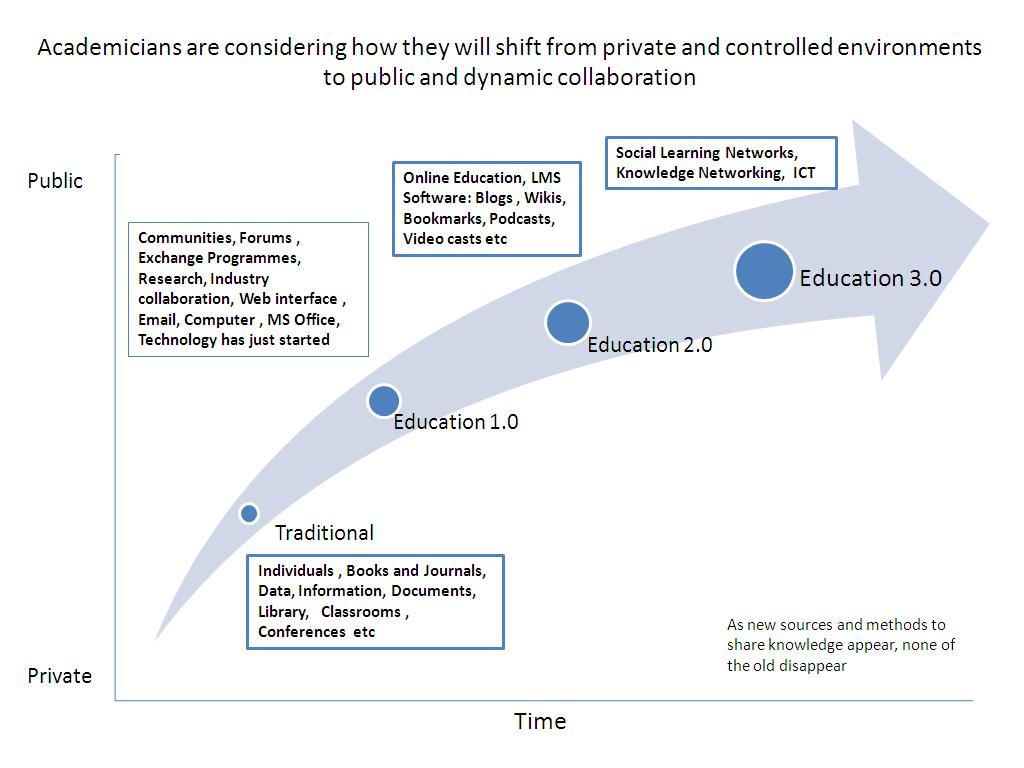
Here I would like to give you a glimpse of Education how it got transformed into present state.

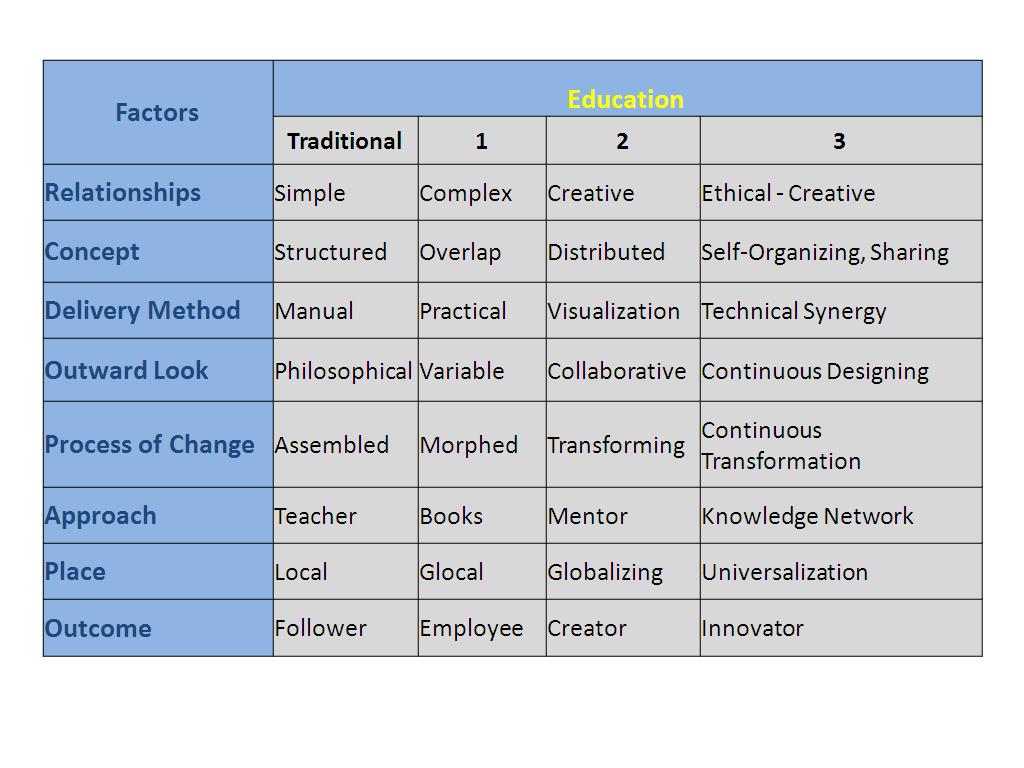
Factors of Transformation

Factors of Education Transformation

Traditional refers to pre-industrial and post-agricultural society that was based on linear, task-oriented relationships. The role of the corresponding regime was to create followers of the traditional family based systematic processes.

Education 1.0 refers to post-industrial society that is been driven by glocal and the little impact of Computers. In this paradigm, technology has been entered in the last stages and it has been used as a medium in developed nations for delivering purpose.

Education 2.0 refers to present technological/digital society driven by globalizing thought process and a collaborative approach with ICT as medium of tool in building and transforming the education system. Thanks to social networking, information is no longer as important as the knowledge that’s created as we interpret information and create meaning. Increasingly, people are becoming more valued for their personal knowledge rather than their ability to perform tasks. Moreover, rapidly evolving information and communications technologies allow us to socially construct knowledge in new ways (i.e., social networking tools). The role of Education 2.0 is to develop our talents to compete in a global market with new social relationships, and where we are able to leverage our knowledge.

Education 3.0 refers to the emerging innovation based knowledge society which is not quite here, yet. This is a society that is driven by accelerating change, universalized relationships, and fueled by knowledge networking. In an era of accelerating change, the amount of information available doubles at an increasing rate, and the half-life of useful knowledge decreases exponentially. This requires innovative thinking and action by all members of society. Social Learning takes over Social Networking.

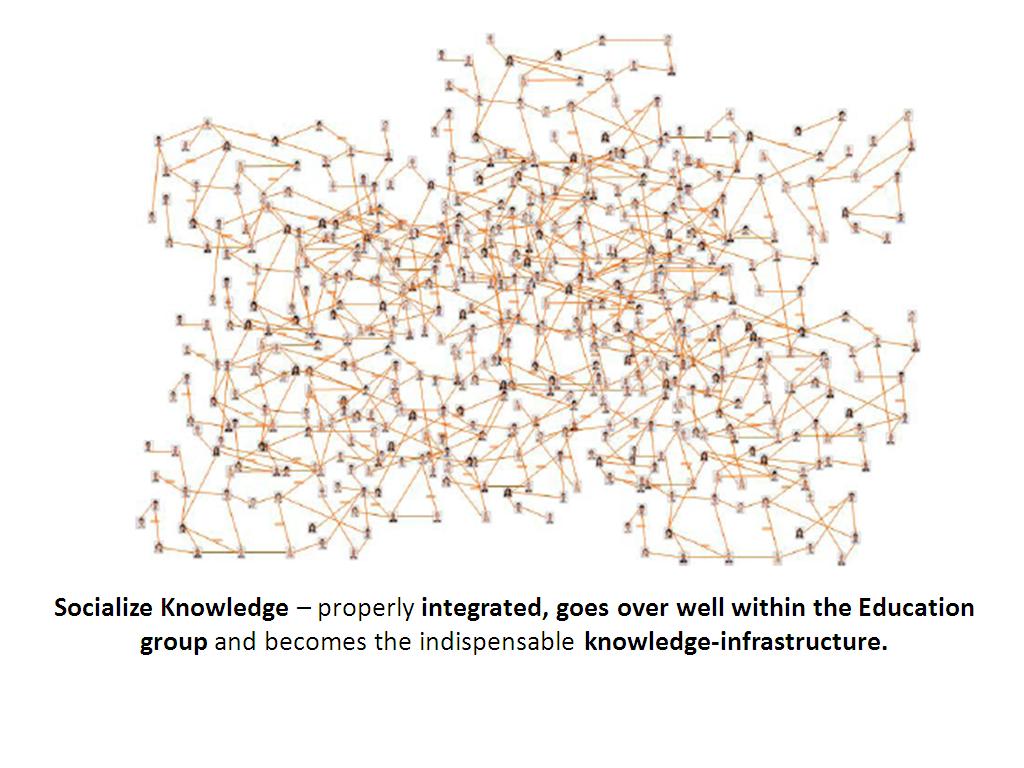
Knowledge Networking

Challenges

Those thinking about tapping the opportunities in the education sector should also take note of the typical challenges. It’s not as simple as installing a PC and running a CBT (Computer Based Training) package.  “There are many challenges when setting up projects at each level. One challenge is the consistency in the way teaching is done. The second challenge is that, small schools & colleges with limited staff. The teacher plays multiple roles—as a teacher, administrator, principal and one who is highly respected at the local community level. So the challenge lies in consistency in the delivery of education and also in evaluation. In that context digital technology gives you the ability to bring about a standard in the delivery of education.” Language and contextualization is one of the bigger challenges. “The teachers and students should be able to relate to the content, rather than just mug it up.”

ICT can certainly help in disseminating educational content, and facilitate remote learning. It can overcome challenges like teacher shortage and student dropout—and bridge the digital divide.