
Use of ICT in the education sector, though recent, has picked up fast.
Computer has bought the revolution in the field of education exploring and expanding towards new extremes. Thanks to Social Networking which added pepper to give it a perfect blend. Previously cable television was the medium for expanding the education, coaching classes set up dedicated channels for distance learning. Then VSAT technology extended this to remote regions. Now it is digital television with service providers beaming educational programs for school children into homes and schools. That’s where ICT comes into picture.
We have been witnessing lots of radical changes and fast paced growth in education sector all over the world supported by factors like:
- Digital / Technological Revolution
- Social Networking
- Telecom Coverage
- Hardware Penetration (Laptops, PC etc)
So far we haven’t used much of these Upto satisfactory levels! Infact if we question ourselves, is education reaching all?
It had just begun; we started identifying Information Communication Technology as a medium. Using of technology for delivering has started in most of the developing countries, this would be a good sign, as in developed countries opportunities for education are little ahead.
Availability of prospective and transformative education system is considered to be a crucial factor for the development of human resources for any country, ensuring that fruits of economic growth reach the masses and the development is sustained. The thrust of global economies to emerge as the knowledge economy has also reinforced education as the key economic and business driver.
Here I would like to give you a glimpse of Education how it got transformed into present state.
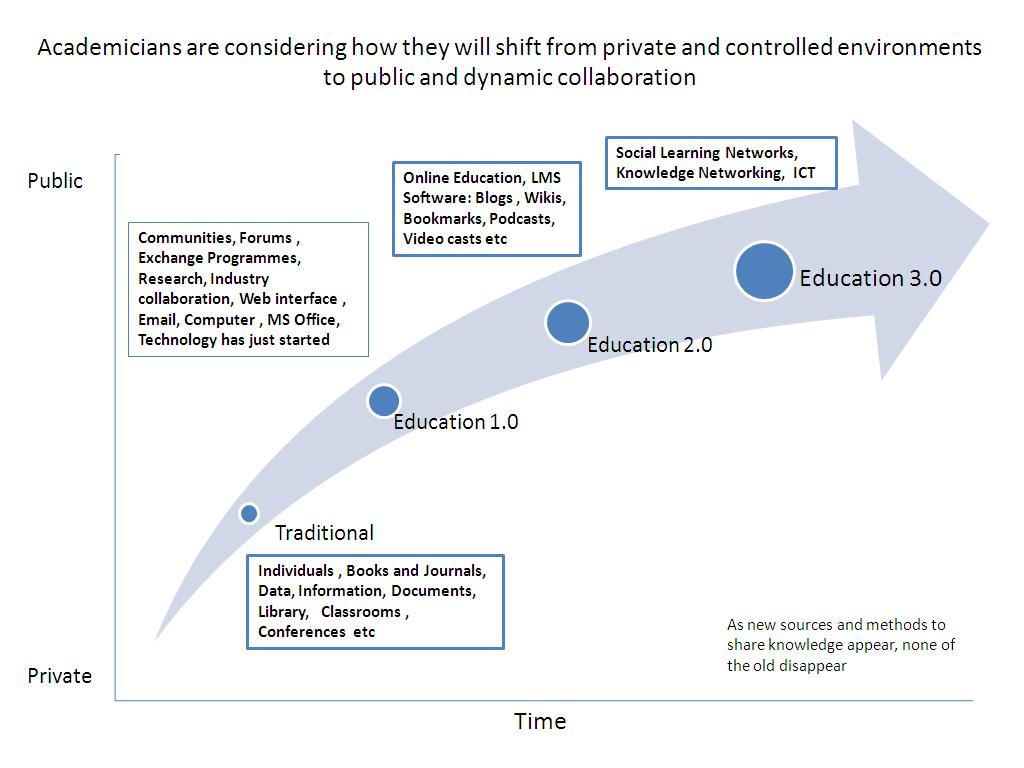
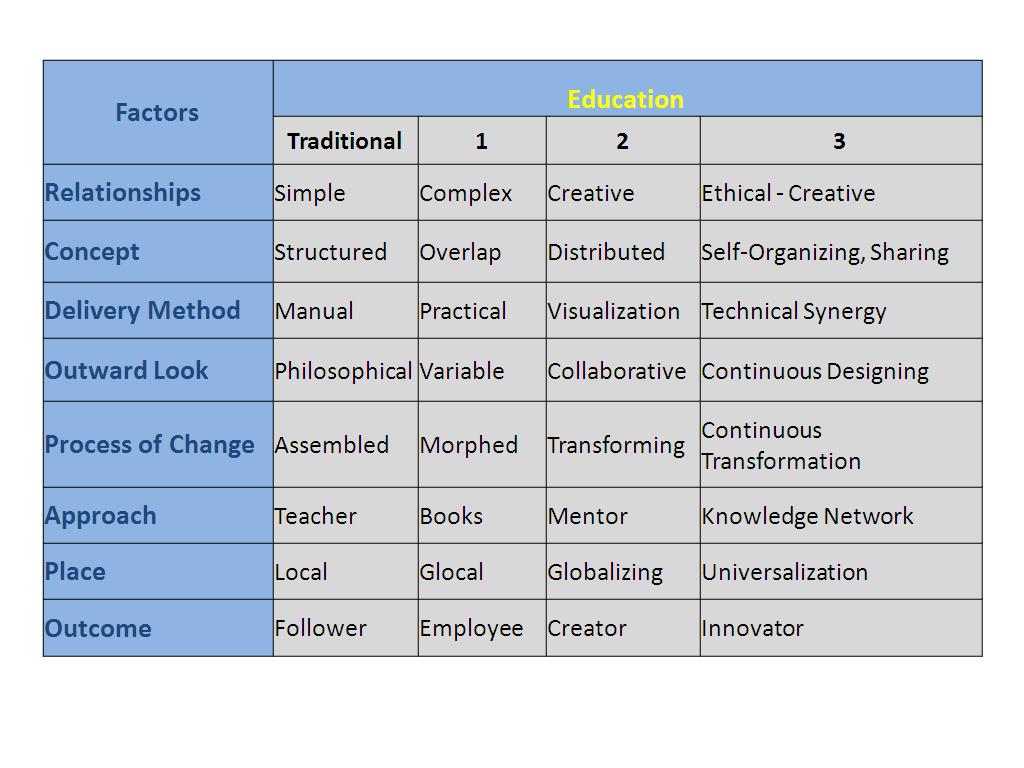
Traditional refers to pre-industrial and post-agricultural society that was based on linear, task-oriented relationships. The role of the corresponding regime was to create followers of the traditional family based systematic processes.
Education 1.0 refers to post-industrial society that is been driven by glocal and the little impact of Computers. In this paradigm, technology has been entered in the last stages and it has been used as a medium in developed nations for delivering purpose.
Education 2.0 refers to present technological/digital society driven by globalizing thought process and a collaborative approach with ICT as medium of tool in building and transforming the education system. Thanks to social networking, information is no longer as important as the knowledge that’s created as we interpret information and create meaning. Increasingly, people are becoming more valued for their personal knowledge rather than their ability to perform tasks. Moreover, rapidly evolving information and communications technologies allow us to socially construct knowledge in new ways (i.e., social networking tools). The role of Education 2.0 is to develop our talents to compete in a global market with new social relationships, and where we are able to leverage our knowledge.
Education 3.0 refers to the emerging innovation based knowledge society which is not quite here, yet. This is a society that is driven by accelerating change, universalized relationships, and fueled by knowledge networking. In an era of accelerating change, the amount of information available doubles at an increasing rate, and the half-life of useful knowledge decreases exponentially. This requires innovative thinking and action by all members of society. Social Learning takes over Social Networking.
Challenges
Those thinking about tapping the opportunities in the education sector should also take note of the typical challenges. It’s not as simple as installing a PC and running a CBT (Computer Based Training) package. “There are many challenges when setting up projects at each level. One challenge is the consistency in the way teaching is done. The second challenge is that, small schools & colleges with limited staff. The teacher plays multiple roles—as a teacher, administrator, principal and one who is highly respected at the local community level. So the challenge lies in consistency in the delivery of education and also in evaluation. In that context digital technology gives you the ability to bring about a standard in the delivery of education.” Language and contextualization is one of the bigger challenges. “The teachers and students should be able to relate to the content, rather than just mug it up.”
ICT can certainly help in disseminating educational content, and facilitate remote learning. It can overcome challenges like teacher shortage and student dropout—and bridge the digital divide.























 Vision2mission's Blog