Empowering Young Minds – Design Thinking way

With exponential growth in the industry and the emergence of technologies, the need for skilled professionals is also increasing. The evolution of technologies is changing the dynamics of the industry and staying relevant with the necessary skills is the need of the hour.

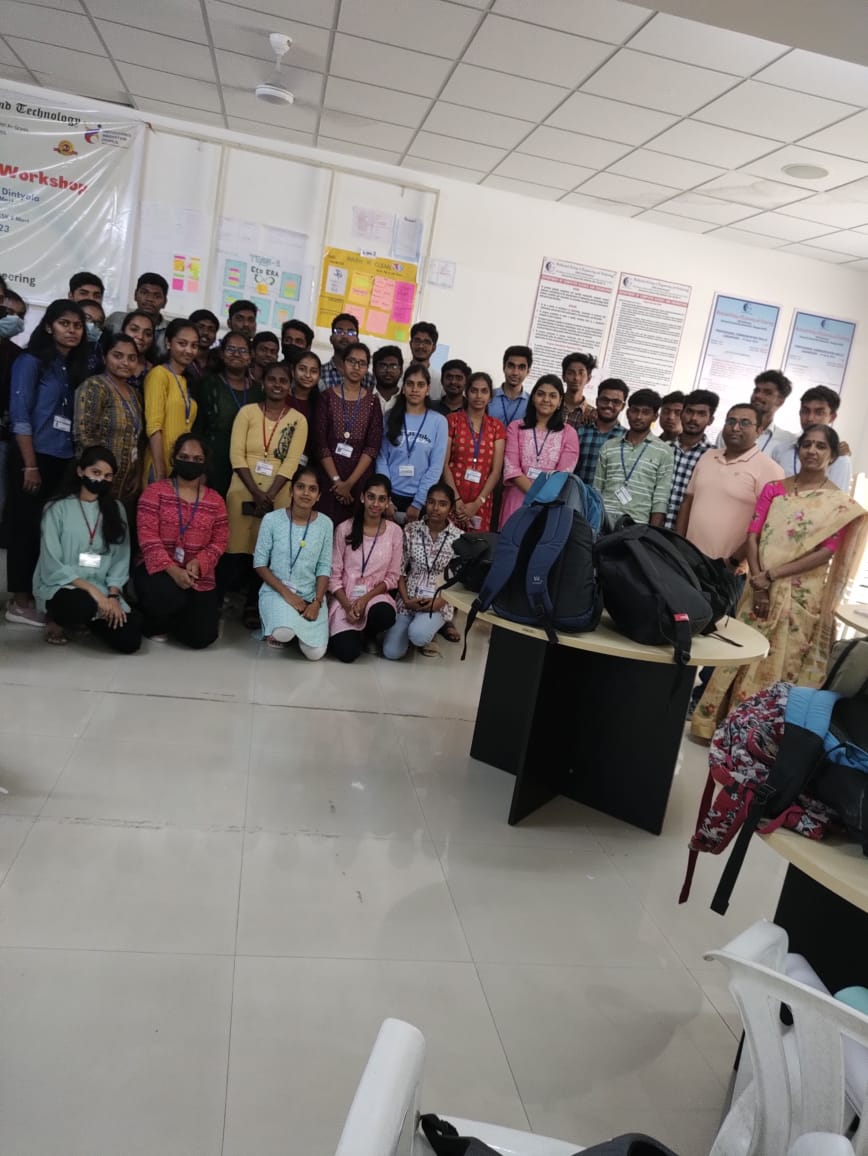
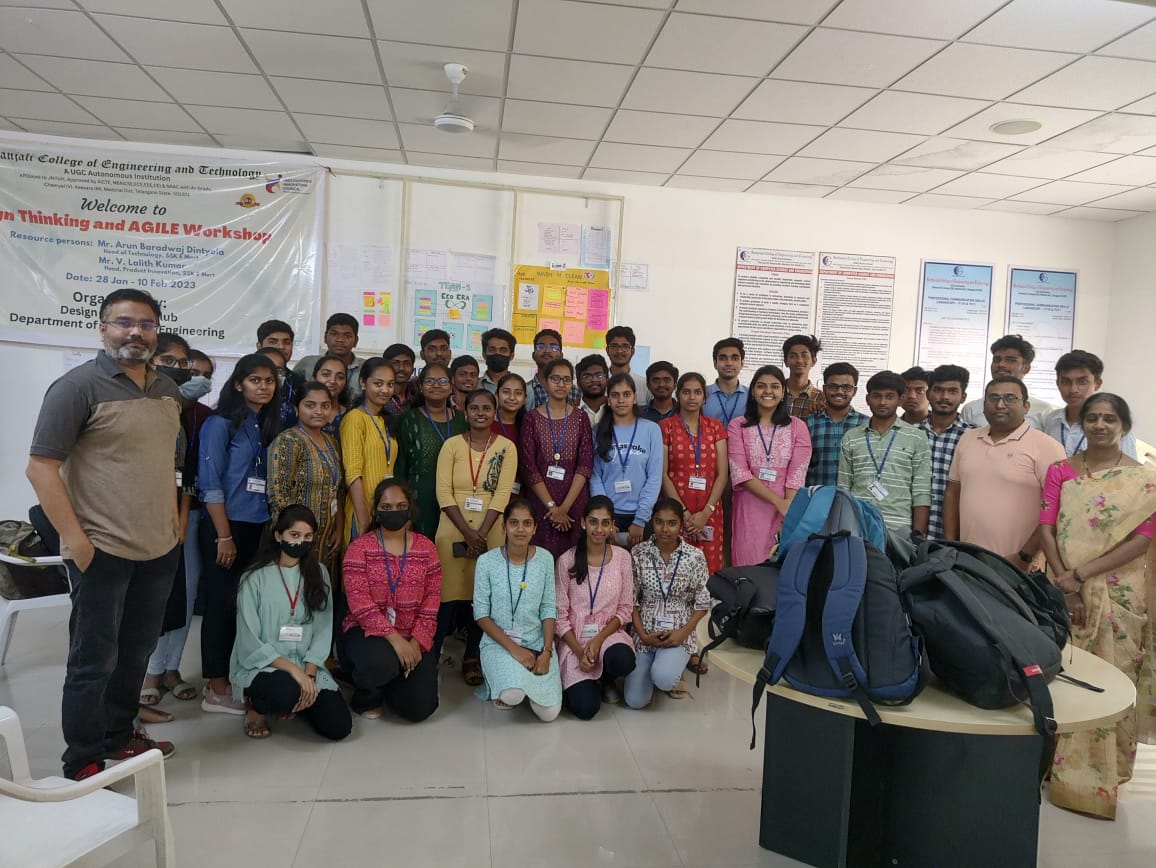
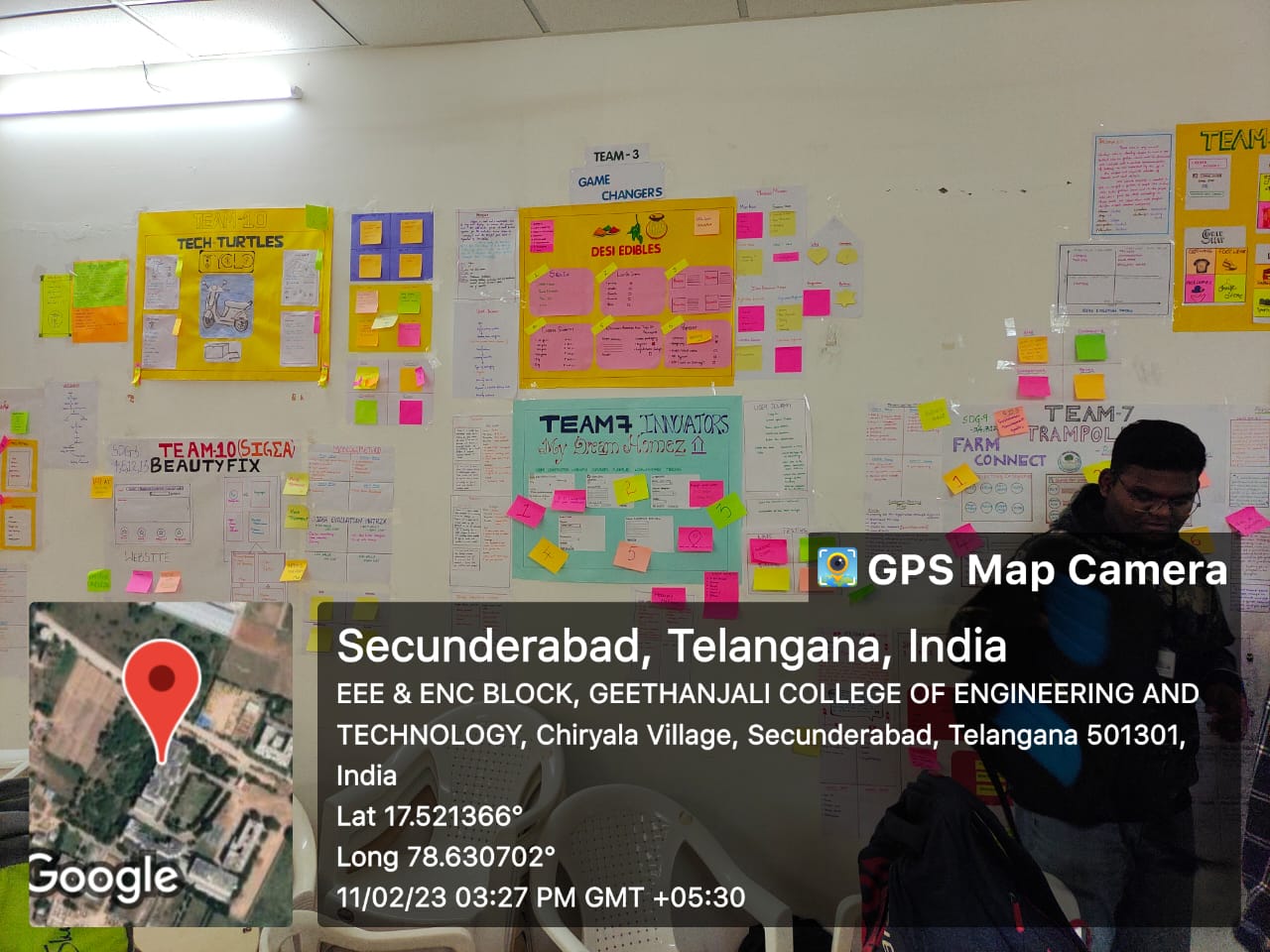
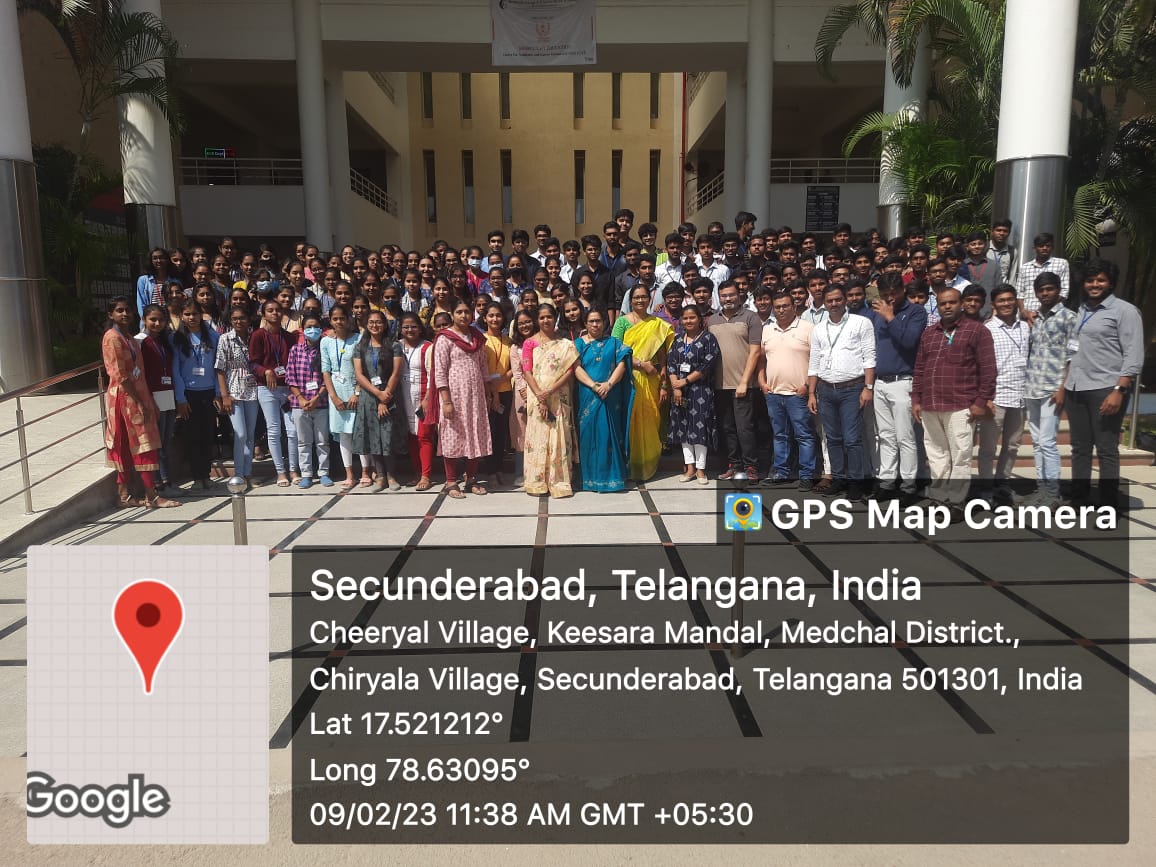
In order to inculcate analytical ability, critical thinking, problem-solving skills, ideation & innovation among Freshman engineering students, Geethanjali College of Engineering and Technology, Cheeryal Village, Keesara Mandal had conducted 2-day workshops each on Design Thinking & Agile spread across 15 days. Around 270 young minds underwent Design Thinking & Agile way of looking to solve problem statements.

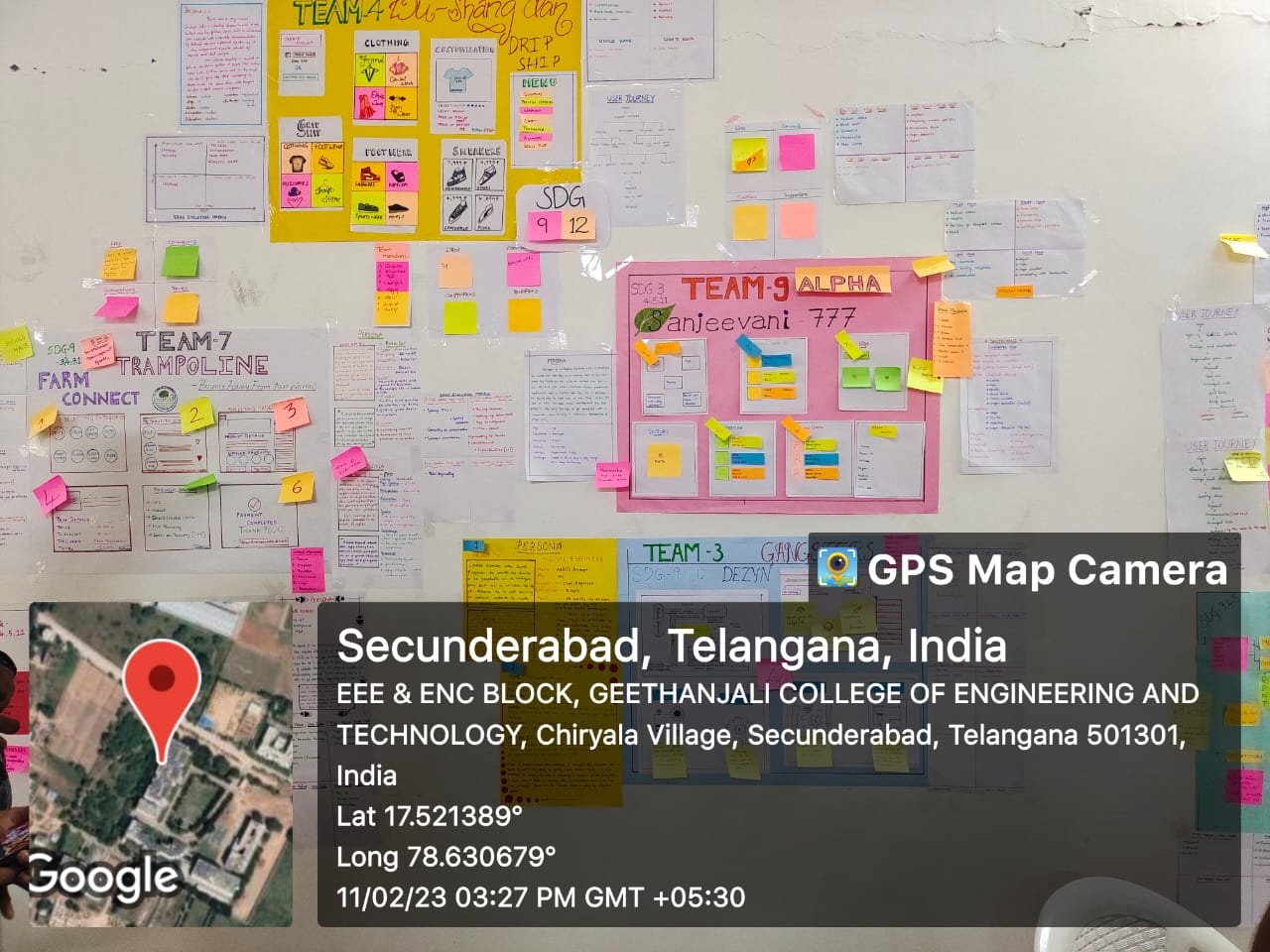
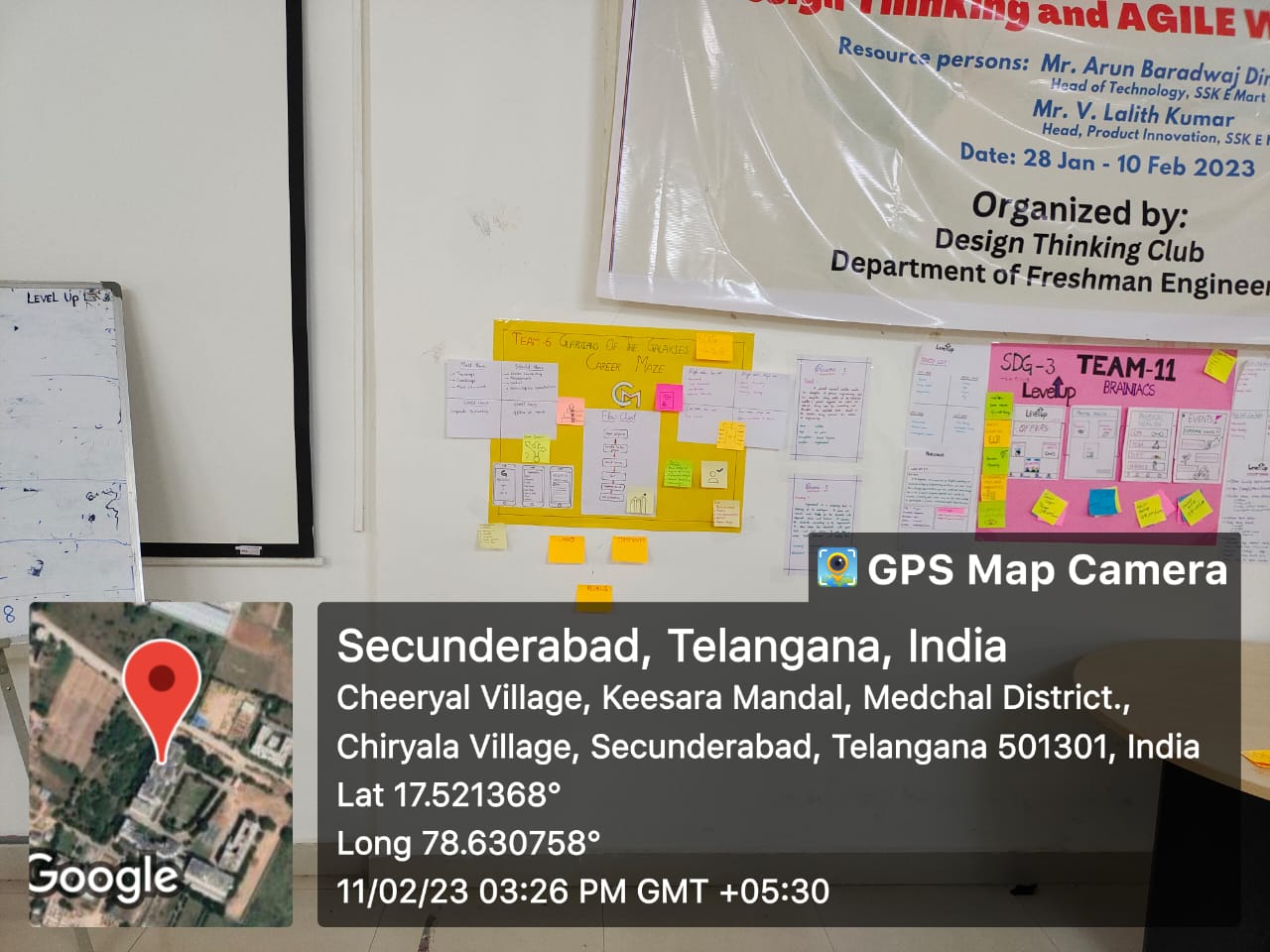
Around 33 students’ ideas are been guided in a Design Thinking & Agile way. This workshop gave students hands-on experience in creating empathy maps, idea evaluation, creating customer journey maps, persona, prototype creation, and testing the concept/product.

Some of the standout Projects include

Foodicted, FarmConnect, My Dream Homez, Sanjeevani 777, Desi Edibles, LevelUp, Eco Era, Athidi Devobhava & Yolo

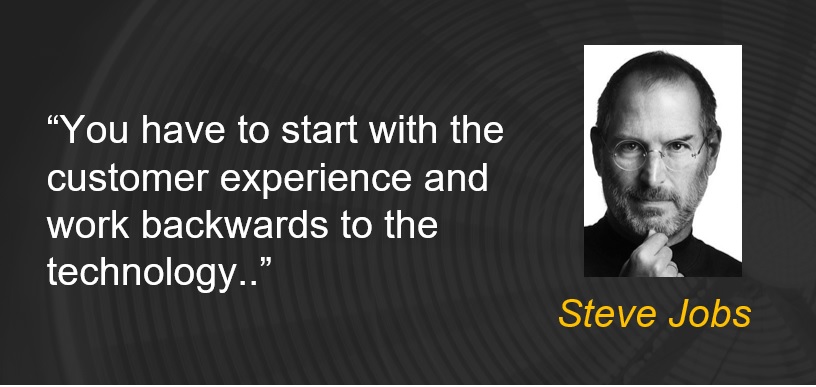
These ideas have real potential and focused on customer experience with a human-centered approach to Innovation. Each idea itself is unique in solving the customer needs of a Farmer, Retailer, Working professional, common man, Traveller, Fitness freak, Health freak, environment enthusiast, etc.

It was heartening to see young minds with an innovative bent and mindset. Special Thanks to Geethanjali College Teaching & Non-teaching staff for making this successful in a seamless way.

Sustainability

Give a man a fish and you feed him for a day. Teach a man to fish and you feed him for a lifetime

Taking a pie from the above said Chinese Quote, if we ourselves start implementing sustainable methodologies at our day-day level and then at family, community, city, state levels one can see the change and its impact in long run. HereSustainability mean every thing like EnvironmentHealthEducation, economic etc that which has social dimensions. I feel one should take always keep in their mind to SEE (Social, Environment, Economic).

SEE can be defined as Social conditions are directly proportional to Environmental conditions which are further directly proportional to Economic situation of any place or society as a whole. The seed of all problems here is Social Conditions, if we can bring change to this, the impact will be on a whole SEE. To change the social conditions the tool could be self sustainable solution.

Self sustainable thoughts should germinate among the youth- the enthusiastic gen next, as this fraternity is going to lead in coming days. Cluster wise implementations should happen leading to a possible full fledged solution. If all the above happens, no wonder within 10 to 20 years we can see Self Sustainable world.

ICT based Teacher Training

Change is to be accepted, As we are marching towards 21st century carrying Information, Communication, Technology as buzz words with us. One can see rapid transformation in the methodologies of teaching. Today children are getting lot of exposure towards learning new things and lots of questions from their little minds. A question to all of us – Are we ready to face those questions ?

The answer may be Yes or No !  But we should be able to answer atleast few questions, as we would guide them upto certain level. Hence it came in my mind, Teachers and parents need to have ICT based training.

ICT based Training means, usage of Technology and its support to teachers. Along with the Teacher training curriculam one needs to under go training with regards to usage of PC, Digital boards, etc.  We can also add concept mapping based education in order to encourage the teacher to train the student in a problem solving orientation and inquiry based education, this would lead to creative and innovative thinking both from the teacher and student mindset.

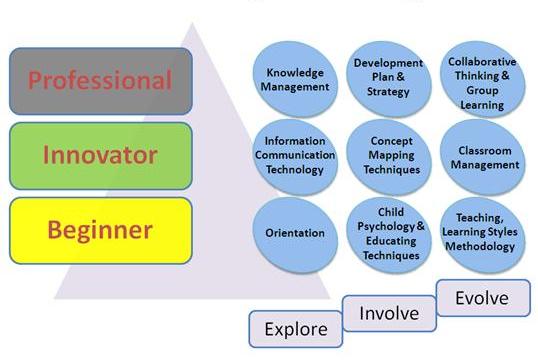
Levels of Training
Teach the Teacher

Each level is categorized with different methods of learning and a collaborative approach would really hel teachers to sustain themselves in a Learn – Un Learn – Re Learn atmosphere.

Learning is part, but implementing effectively is a process where Un learning takes place and innovation arises, this is where every teacher need to concentrate and this would really be helpful for a better student upliftment.

Future – ICT in Education sector

Knowledge, Networking, ICT, Education, Socializing, Society

Use of ICT in the education sector, though recent, has picked up fast.

Computer has bought the revolution in the field of education exploring and expanding towards new extremes. Thanks to Social Networking which added pepper to give it a perfect blend. Previously cable television was the medium for expanding the education, coaching classes set up dedicated channels for distance learning. Then VSAT technology extended this to remote regions. Now it is digital television with service providers beaming educational programs for school children into homes and schools. That’s where ICT comes into picture.

We have been witnessing lots of radical changes and fast paced growth in education sector all over the world supported by factors like:

  • Digital / Technological Revolution
  • Social Networking
  • Telecom Coverage
  • Hardware Penetration (Laptops, PC etc)

So far we haven’t used much of these Upto satisfactory levels! Infact if we question ourselves, is education reaching all?

It had just begun; we started identifying Information Communication Technology as a medium. Using of technology for delivering has started in most of the developing countries, this would be a good sign, as in developed countries opportunities for education are little ahead.

Availability of prospective and transformative education system is considered to be a crucial factor for the development of human resources for any country, ensuring that fruits of economic growth reach the masses and the development is sustained. The thrust of global economies to emerge as the knowledge economy has also reinforced education as the key economic and business driver.

Here I would like to give you a glimpse of Education how it got transformed into present state.
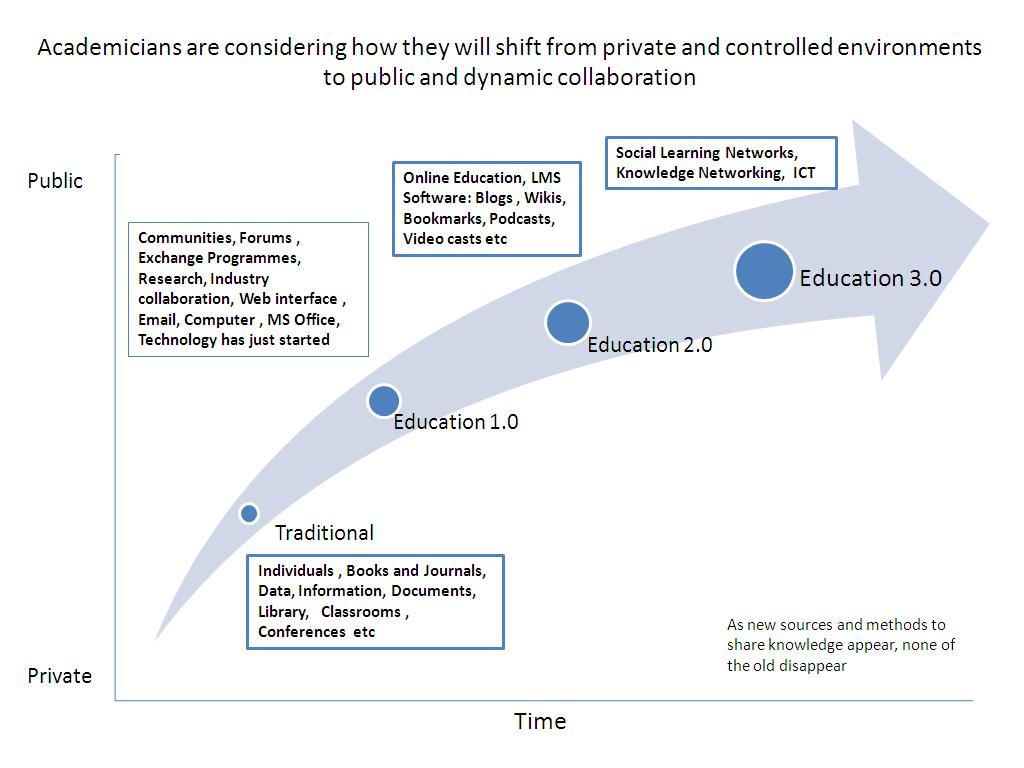
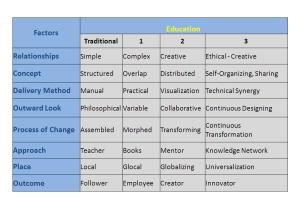
Factors of Transformation

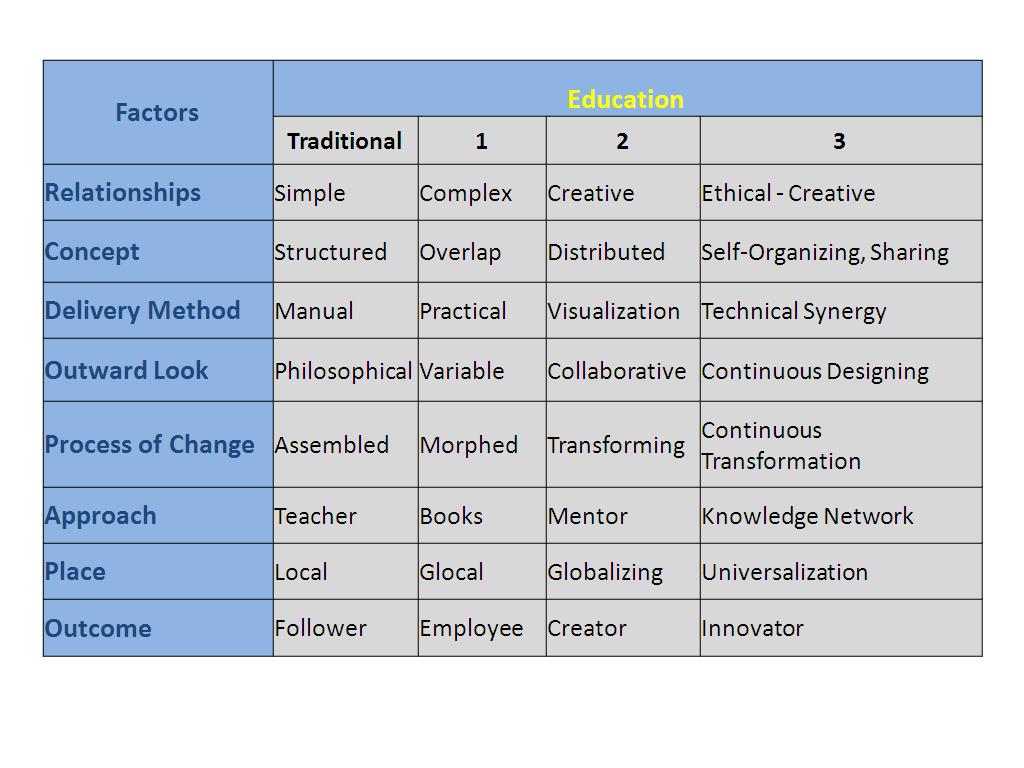
Factors of Education Transformation

Traditional refers to pre-industrial and post-agricultural society that was based on linear, task-oriented relationships. The role of the corresponding regime was to create followers of the traditional family based systematic processes.

Education 1.0 refers to post-industrial society that is been driven by glocal and the little impact of Computers. In this paradigm, technology has been entered in the last stages and it has been used as a medium in developed nations for delivering purpose.

Education 2.0 refers to present technological/digital society driven by globalizing thought process and a collaborative approach with ICT as medium of tool in building and transforming the education system. Thanks to social networking, information is no longer as important as the knowledge that’s created as we interpret information and create meaning. Increasingly, people are becoming more valued for their personal knowledge rather than their ability to perform tasks. Moreover, rapidly evolving information and communications technologies allow us to socially construct knowledge in new ways (i.e., social networking tools). The role of Education 2.0 is to develop our talents to compete in a global market with new social relationships, and where we are able to leverage our knowledge.

Education 3.0 refers to the emerging innovation based knowledge society which is not quite here, yet. This is a society that is driven by accelerating change, universalized relationships, and fueled by knowledge networking. In an era of accelerating change, the amount of information available doubles at an increasing rate, and the half-life of useful knowledge decreases exponentially. This requires innovative thinking and action by all members of society. Social Learning takes over Social Networking.
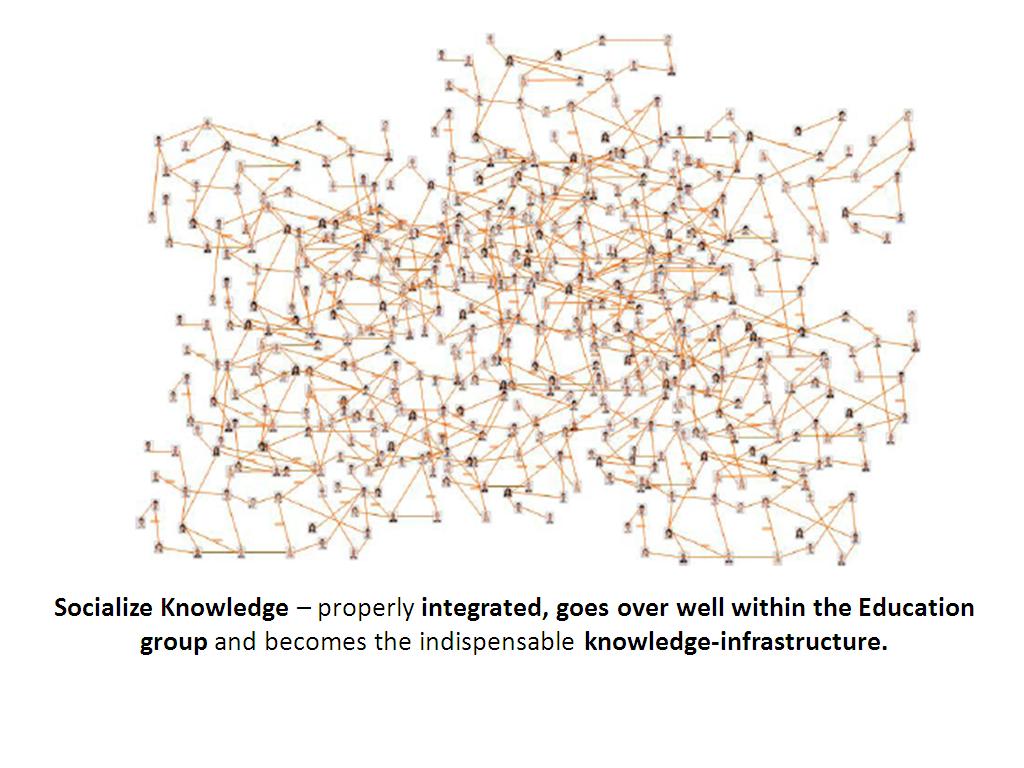
Knowledge Networking

Challenges

Those thinking about tapping the opportunities in the education sector should also take note of the typical challenges. It’s not as simple as installing a PC and running a CBT (Computer Based Training) package.  “There are many challenges when setting up projects at each level. One challenge is the consistency in the way teaching is done. The second challenge is that, small schools & colleges with limited staff. The teacher plays multiple roles—as a teacher, administrator, principal and one who is highly respected at the local community level. So the challenge lies in consistency in the delivery of education and also in evaluation. In that context digital technology gives you the ability to bring about a standard in the delivery of education.” Language and contextualization is one of the bigger challenges. “The teachers and students should be able to relate to the content, rather than just mug it up.”

ICT can certainly help in disseminating educational content, and facilitate remote learning. It can overcome challenges like teacher shortage and student dropout—and bridge the digital divide.

In search of . . .

World is a global village, but have seen different culture,systems, ecosystems in each and every place. Few are failures and few are success in each and every aspect, A question araises in my mind saying, why do these differ ? why do they change ? Another one is Do human brain changes and behaves differently when we change place, system, region, culture etc?

Iam in search of this hidden secret which brings new paradigms in Education development.