
Journey to 100 Years of Independent India

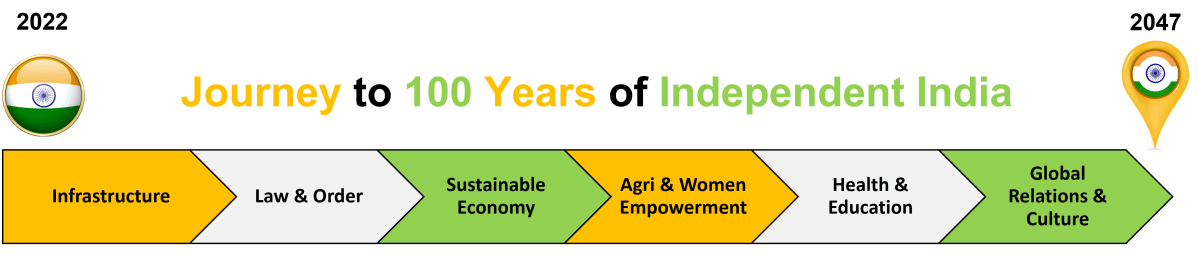
75 years of Independent India!

A lot happened, and a lot is yet to happen. No country is perfect nor the people, every country has its own challenges be it Political, Geographical, or whatsoever. While the challenges always seem invincible, there is always a way to find solutions to each and every problem. As a nation, we have achieved many great things which is evident in history.

This is the right time to create goals for the next 25 years (marking 100 Years of Independence, the Year 2047).

25 aspects India need to focus in the next 25 years to become Self-reliant and Sustainable India
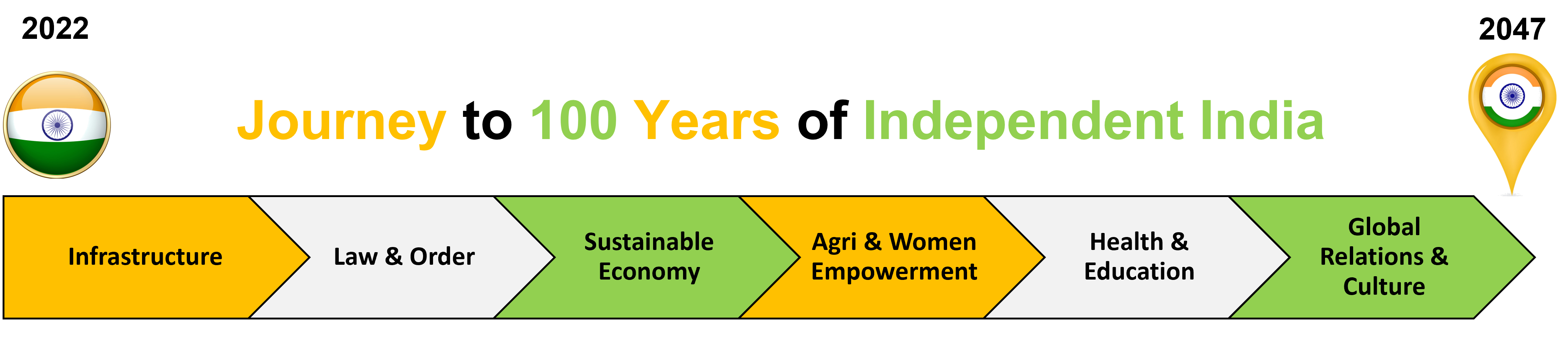
Infrastructure

  • Renewable Energy: Ability to achieve energy consumption needs through renewable sources without burning fossil fuels and creating pollution
  • Rail, Road, Air, Water Connectivity: To unleash the potential of India, a network across all 4 channels forming a hybrid grid is highly needed
  • Tech & Manufacturing Parks: Build Tech & Manufacturing Hubs across each state further dividing into clusters, thereby inviting investments with friendly business policies
  • Affordable & Sustainable Housing: Shelter for all citizens is critical and building sustainable homes is key agenda to achieve

Law & Order

  • Uniform Civil Law: One Nation One Law to be implemented, thereby reducing Religious intolerance. All are equal before the law, be it, President or Common Man or any religion.
  • Freebie-less Democratic Nation: Abolish welfare schemes that are a burden to the exchequer, be it state or central govt. Respective Political parties to be made responsible for creating a revenue vacuum due to unnecessary welfare schemes. Inclusive Governance is needed.
  • Professional Administration: Digitize the processes of working at all levels in Govt – a Paperless Governing process run by a combination of Civil Servants and Professionals for better administration
  • Taxing Politicians & Political Parties: Fast Track Independent courts to handle Political & Political Parties scams and heavy taxing to be levied as part of recovery basis the count from the respective party.

Sustainable Economy

  • Make in India to Quality Indian Product: Encourage make in India with Quality as a sense of pride in the craftsmanship. This should become a national movement to raise the quality standards of the goods produced in India.
  • Ecosystem Revolution: Connect across Industries, Organizations & Govt Departments, etc, Communicate about the best skills or services they can provide, and Collaborate to achieve the best outcome which fulfills the needs of Citizens.
  • Encouraging Unorganized & MSME Businesses: Small Business Friendly policies are needed which make life simple for citizens to fulfill day-to-day needs. Encourage Local businesses.
  • National Water Grid: Govt must create a National Water Council, which handles the water-sharing agreements between states & union territories. This National Water Grid must be implemented in a phased manner with the agreements reviewed every 3-5 years.
  • Increase Economic Stability: The flow of Capital and Liquidity needs to be increased. Banks and other financial institutions are facing a liquidity crunch. The government should help them with cash support. This reduces the uncertainty in Investments.
  • Invest in high-potential sectors with strong FDI Policies: India has the great opportunity to achieve $1 trillion in economic value by establishing itself as a hub for manufacturers of electronics, defense, space, medical, chemicals, textiles, auto goods, and pharmaceuticals. By increasing investments in these sectors, India would not only increase its potential for exports but also decrease its reliance on imports, curbing the amount of money spent by citizens on foreign products.

Agri & Women Empowerment

  • Increase Agricultural Growth: India shouldn’t drop the Agri sector from their focus, we need to go back to our strength. Govt must train more people in agriculture and different ways of farming and provide technical support to youngsters who wish to take up farming.
  • Urbanizing Rural India by Providing Infra support: Investing in better infra and urban services, such as transportation & water management in Rural areas would create a resurgence of the housing market and give banks more lending opportunities. Inevitably, more development and urbanization would create new opportunities for international investments, eco-tourism, and manufacturing exports.
  • Natural Farming Approaches: Encourage natural farming and commercial crop farming as traditional crop farming is creating imbalances in supply and demand.
  • Strong Farm & Women Laws: Strong Farm laws for open and transparent minimum support prices need to be implemented and Govt to create a platform to open channels directly for foreign export where excess availability. The role of women is integral to a sustainable future, Naari Shakti is going to be Desh ki Shakti. Strong policy on this which is inclusive from top and bottom is highly required.

Health & Education

  • Right to Uniform Value-based Education & Skills: Right to Education to be re-named as Right to Uniform Value-based Education, a fundamental right to provide uniform value-based education to every child in India. It must not only concentrate on school education but also help graduates to improve their skill levels and values in building a peaceful society. Proper world-class training must be given to graduates in Industrial skills, vocational & character building skills.
  • Encourage Medical Research, Innovation & Manufacturing (Medical Devices): Encourage investments in Medical Research and Manufacturing of medical devices through the Make in Quality Indian Product initiative. Encourage Innovation in bringing back our Vedic health approaches to the world for benefit of a better healthy society.
  • Public – Private – Community Organization Collaborations – Health & Education Projects: Public-private and NGO partnerships can help achieve govt initiatives to be successfully implemented in both Health & Education sectors in collaboration be it, project management, processes, best practices, and quality control. Govt should provide tax benefits & other incentives to encourage private participation in key areas of healthcare & education while ensuring sustainability instead of forcing CSR.
  • Right to Primary Health care: The experiences across the world in the wake of the Covid-19 pandemic have made an emphatic case for increased public investment in health expenditure. Public health should indeed be deemed non-excludable and non-rivalrous and hence a public good similar to national defense as defined by the economist Paul Samuelson. Right to Primary Healthcare to be made an integral part of Right to Life under Article 21. This ensures healthy and preventive measures at the initial stages of the disease before getting worsens.

Global Relations & Culture

  • Universalist Mindset: Indian culture has always been Vasudhaiva Kutumbakam very open-ended and kind to embracing the entire universe in its philosophy. In recent times, we have become too “absolutist” with each set of people promoting their own ideas and shutting down others. India needs to go back to its roots and start re-embracing the universalist mindset that makes us unique across the world.
  • Destination Hub – Education, Health, Tourism, Innovation, Farming, Religion & Vedic Culture: Need to have clusters across each state of India for Education, Health, Hospitality, Innovation, Farming, Religion & Vedic Culture, etc which further needs to be connected as Network of Hubs to encourage tourism in these sectors. India is a land of diversified cultures and is known for its heritage, Vedic culture, scenic nature, multiple languages, rich human talent, etc. This is yet to be explored to the core which can add to economic value.
  • Be a Vishwa Guru (Knowledge Hub): India can set an example of how we can move towards modernity and still save ourselves from mindless Westernisation. Our civilizational culture has provided us with a strong philosophical foundation that has several unique features. Our spiritual democracy, where Ekam Sat, Vipra Bahuda Vadanti (the truth is one, but the wise men describe the same differently) serves as the cornerstone of our approach to diverse ways of worship, makes India a home for all religions that live in harmony.

To achieve the above, one need not be a politician, a responsible citizen of India with dreams and high aspirations to build a sustainable and self-reliant India would be enough. Today we might celebrate 75 Years of Independence which is the gift to us by our grandfathers and great grandfathers. It is our responsibility from here on to build on top of it.

Be the Change, I want my India to be Self-reliant, Sustainable, and lead by example. Would you also ?? ??

Sustainability

Give a man a fish and you feed him for a day. Teach a man to fish and you feed him for a lifetime

Taking a pie from the above said Chinese Quote, if we ourselves start implementing sustainable methodologies at our day-day level and then at family, community, city, state levels one can see the change and its impact in long run. HereSustainability mean every thing like EnvironmentHealthEducation, economic etc that which has social dimensions. I feel one should take always keep in their mind to SEE (Social, Environment, Economic).

SEE can be defined as Social conditions are directly proportional to Environmental conditions which are further directly proportional to Economic situation of any place or society as a whole. The seed of all problems here is Social Conditions, if we can bring change to this, the impact will be on a whole SEE. To change the social conditions the tool could be self sustainable solution.

Self sustainable thoughts should germinate among the youth- the enthusiastic gen next, as this fraternity is going to lead in coming days. Cluster wise implementations should happen leading to a possible full fledged solution. If all the above happens, no wonder within 10 to 20 years we can see Self Sustainable world.

Social Media Networking Apps: e-Learning Series

Education needs social media intervention in order to explore ways towards providing learning breaking barriers.

I have gone through very interesting site yesterday by name “Edmodo” which creates free online tools for the education community,  for Schools, Teachers, Students, and parents for use in classroom. It is a social learning network for teachers, students, schools and districts. Provides free classroom communication for teachers, students and administrators on a secure social network. It allows the education community to share classroom materials, links , grades, calendar and notices. It even shares all digital content, blogs, pictures, videos, presentations etc. The interesting aspect is that, it is accessible online or by using any mobile device, including Android and i Phones.


Edmodo webpage


I felt like, we have many resources which we can utilize at certain and required levels, but the education community is yet to open its wings in  order utilize this simple applications which really helps the teaching and student community providing way for shared knowledge, as many times i say, Knowledge when not shared, it is mere waste.

Knowledge Networking really gonna be the 21st century buzzword which is the next level of Social Media Networking, as far as i feel till date 🙂

Wait for the next Social Media App 🙂

ICT based Teacher Training

Change is to be accepted, As we are marching towards 21st century carrying Information, Communication, Technology as buzz words with us. One can see rapid transformation in the methodologies of teaching. Today children are getting lot of exposure towards learning new things and lots of questions from their little minds. A question to all of us – Are we ready to face those questions ?

The answer may be Yes or No !  But we should be able to answer atleast few questions, as we would guide them upto certain level. Hence it came in my mind, Teachers and parents need to have ICT based training.

ICT based Training means, usage of Technology and its support to teachers. Along with the Teacher training curriculam one needs to under go training with regards to usage of PC, Digital boards, etc.  We can also add concept mapping based education in order to encourage the teacher to train the student in a problem solving orientation and inquiry based education, this would lead to creative and innovative thinking both from the teacher and student mindset.

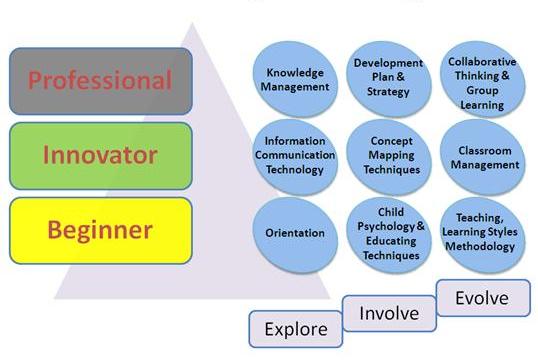
Levels of Training
Teach the Teacher

Each level is categorized with different methods of learning and a collaborative approach would really hel teachers to sustain themselves in a Learn – Un Learn – Re Learn atmosphere.

Learning is part, but implementing effectively is a process where Un learning takes place and innovation arises, this is where every teacher need to concentrate and this would really be helpful for a better student upliftment.

Future – ICT in Education sector

Knowledge, Networking, ICT, Education, Socializing, Society

Use of ICT in the education sector, though recent, has picked up fast.

Computer has bought the revolution in the field of education exploring and expanding towards new extremes. Thanks to Social Networking which added pepper to give it a perfect blend. Previously cable television was the medium for expanding the education, coaching classes set up dedicated channels for distance learning. Then VSAT technology extended this to remote regions. Now it is digital television with service providers beaming educational programs for school children into homes and schools. That’s where ICT comes into picture.

We have been witnessing lots of radical changes and fast paced growth in education sector all over the world supported by factors like:

  • Digital / Technological Revolution
  • Social Networking
  • Telecom Coverage
  • Hardware Penetration (Laptops, PC etc)

So far we haven’t used much of these Upto satisfactory levels! Infact if we question ourselves, is education reaching all?

It had just begun; we started identifying Information Communication Technology as a medium. Using of technology for delivering has started in most of the developing countries, this would be a good sign, as in developed countries opportunities for education are little ahead.

Availability of prospective and transformative education system is considered to be a crucial factor for the development of human resources for any country, ensuring that fruits of economic growth reach the masses and the development is sustained. The thrust of global economies to emerge as the knowledge economy has also reinforced education as the key economic and business driver.

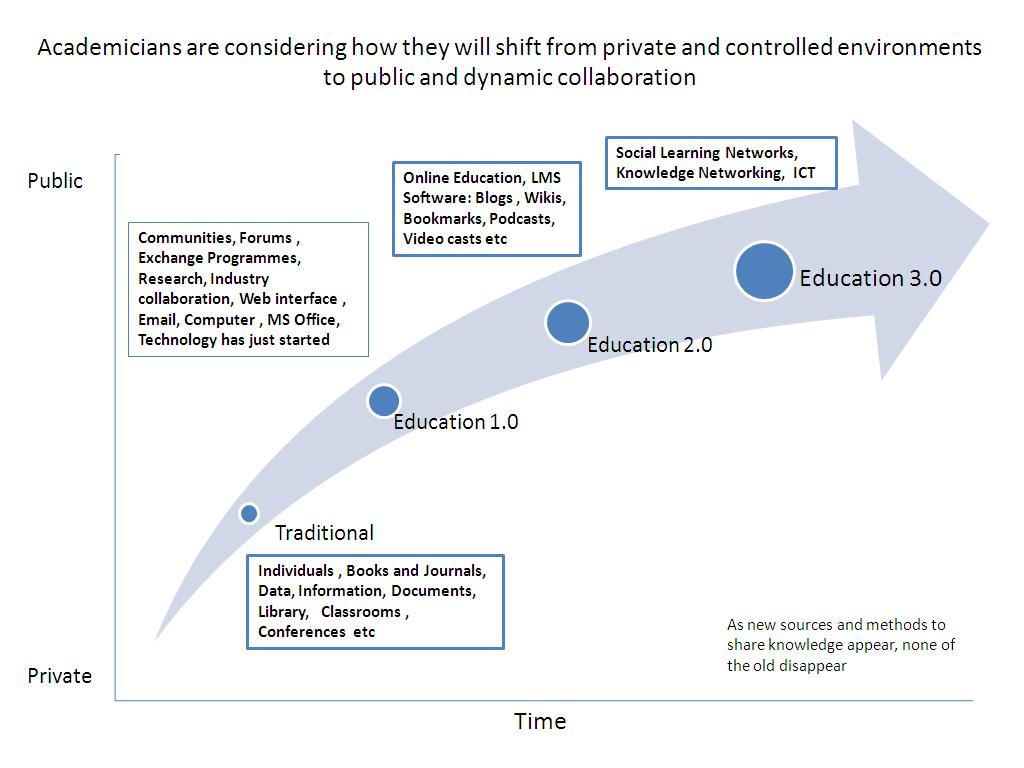
Here I would like to give you a glimpse of Education how it got transformed into present state.

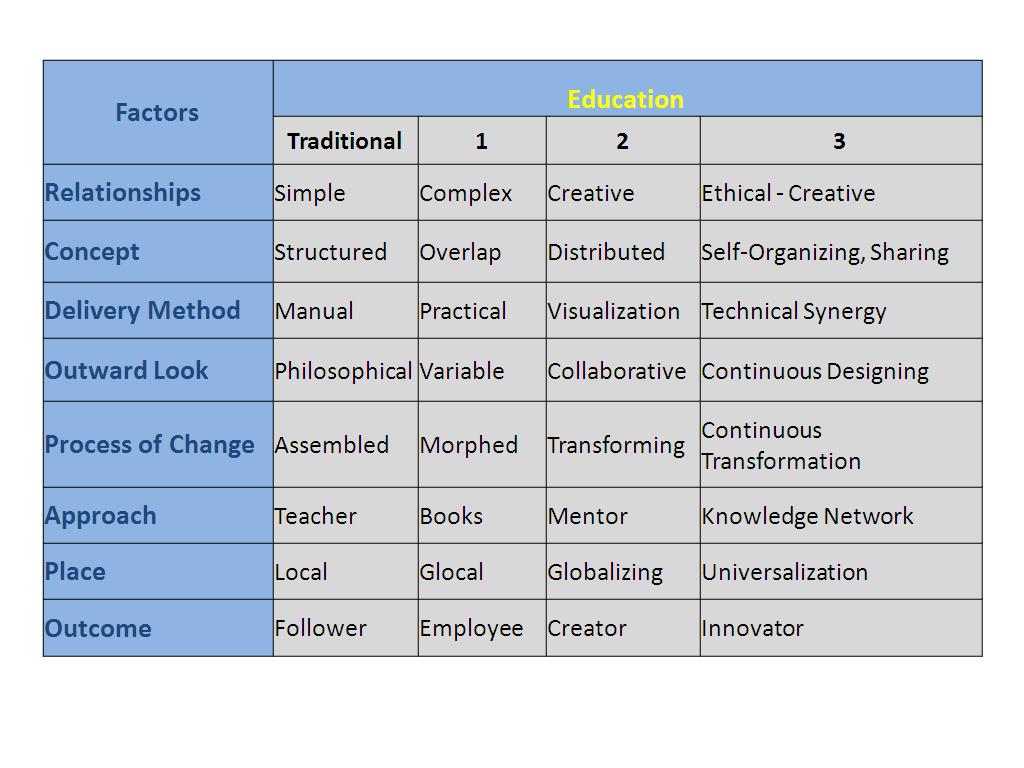
Factors of Transformation

Factors of Education Transformation

Traditional refers to pre-industrial and post-agricultural society that was based on linear, task-oriented relationships. The role of the corresponding regime was to create followers of the traditional family based systematic processes.

Education 1.0 refers to post-industrial society that is been driven by glocal and the little impact of Computers. In this paradigm, technology has been entered in the last stages and it has been used as a medium in developed nations for delivering purpose.

Education 2.0 refers to present technological/digital society driven by globalizing thought process and a collaborative approach with ICT as medium of tool in building and transforming the education system. Thanks to social networking, information is no longer as important as the knowledge that’s created as we interpret information and create meaning. Increasingly, people are becoming more valued for their personal knowledge rather than their ability to perform tasks. Moreover, rapidly evolving information and communications technologies allow us to socially construct knowledge in new ways (i.e., social networking tools). The role of Education 2.0 is to develop our talents to compete in a global market with new social relationships, and where we are able to leverage our knowledge.

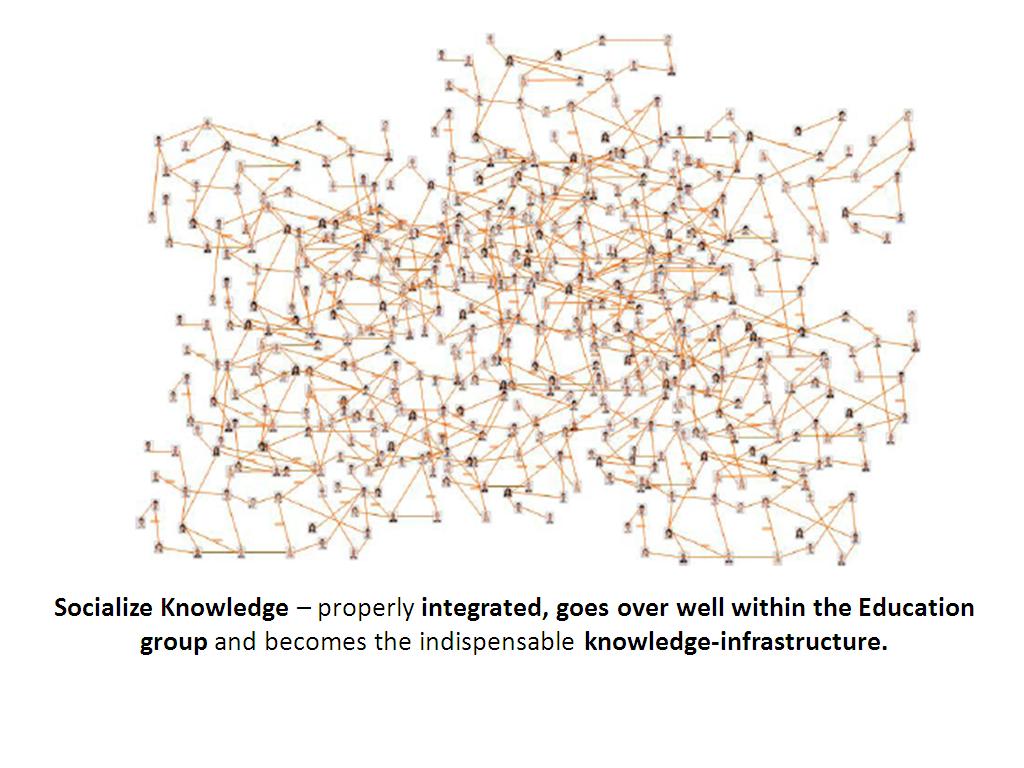
Education 3.0 refers to the emerging innovation based knowledge society which is not quite here, yet. This is a society that is driven by accelerating change, universalized relationships, and fueled by knowledge networking. In an era of accelerating change, the amount of information available doubles at an increasing rate, and the half-life of useful knowledge decreases exponentially. This requires innovative thinking and action by all members of society. Social Learning takes over Social Networking.

Knowledge Networking

Challenges

Those thinking about tapping the opportunities in the education sector should also take note of the typical challenges. It’s not as simple as installing a PC and running a CBT (Computer Based Training) package.  “There are many challenges when setting up projects at each level. One challenge is the consistency in the way teaching is done. The second challenge is that, small schools & colleges with limited staff. The teacher plays multiple roles—as a teacher, administrator, principal and one who is highly respected at the local community level. So the challenge lies in consistency in the delivery of education and also in evaluation. In that context digital technology gives you the ability to bring about a standard in the delivery of education.” Language and contextualization is one of the bigger challenges. “The teachers and students should be able to relate to the content, rather than just mug it up.”

ICT can certainly help in disseminating educational content, and facilitate remote learning. It can overcome challenges like teacher shortage and student dropout—and bridge the digital divide.

Gurukul Education Vs School

Human brain tends to change and synchronizes itself according to circumstances. I have seen this when iam exploring myself at “Kala Ashram”. A place where i met many intellectuals with different thoughts and ideologies along with different set of religions, age group etc. People meet here to learn, engage and share. Guruji  shares his experiences in the past, how system used to be and how it used to work etc. Learning comes when we have something in our brain which is eating to explore.

Here i have seen a different world which may be a replica of once upon a time in India. The system is set in such a way, one who visits will feel like he is in some Gurukul.

I don’t know whether we do have similar places any where in India, but in a life time i have experienced it. We shared various views related to the Systems that used to be existed in India, different types of rulings, starting from colonial rule to present system. One realizes what we used to be and what we have lost in life due to modernization and liberalization of course even though it bought development, but still it exploited the culture and customs prevailing according to our Indian System or ecology. So many customs, culture are getting extinct due to present day chaos. Can we get rid of this ? Can we safe guard ourselves ? Can we identify solution ?

Since few days i was reading in many news papers, magazines and Internet articles about Indian Education opened new vistas by allowing foreign universities to set up their campuses within India. I was in a dilemma are we lost some where ?

The concept of School came in the minds of British only after seeing the Gurukul System in India, It is our Vedas gave solutions and thought process for scientific innovation and development, and today we are in a state of extinct.

I accept that foreign universities like Harvard’s, MIT, Yale, CMU etc had lot of intellectual capital and research base, but in my opinion these universities should have collaboration campuses with Universities and affiliated or extension campuses with private colleges. This would bring exchange of knowledge and even development of the Education considering world as global village.

Here i would like to add some information with regards to the various educations systems that used to exist in Indian system, we used to have Pottery, Painting, Clay toys, Bamboo toys, music etc. these are not treated as a course list in any education institute ( Music &  Dance is  exceptional). These used to be learnt by the traditional family persons and those were exploited in Industrial revolution, now we could not even see a person who knew those. Pre-British our education system was totally different, infact Britishers could break the Indian jinx and could rule us for 150 years only after disturbing our Indian Education system.

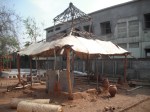
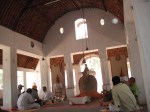
I would share few snaps with regards to “Kala Ashram” where i could see some Gurukul is still prevailing in India.

In search of . . .

World is a global village, but have seen different culture,systems, ecosystems in each and every place. Few are failures and few are success in each and every aspect, A question araises in my mind saying, why do these differ ? why do they change ? Another one is Do human brain changes and behaves differently when we change place, system, region, culture etc?

Iam in search of this hidden secret which brings new paradigms in Education development.